Dr. Dorothy McClellan
Film about Friar Bernardin Sokol draws a large audience;
his tragic fate leaves no one indifferent
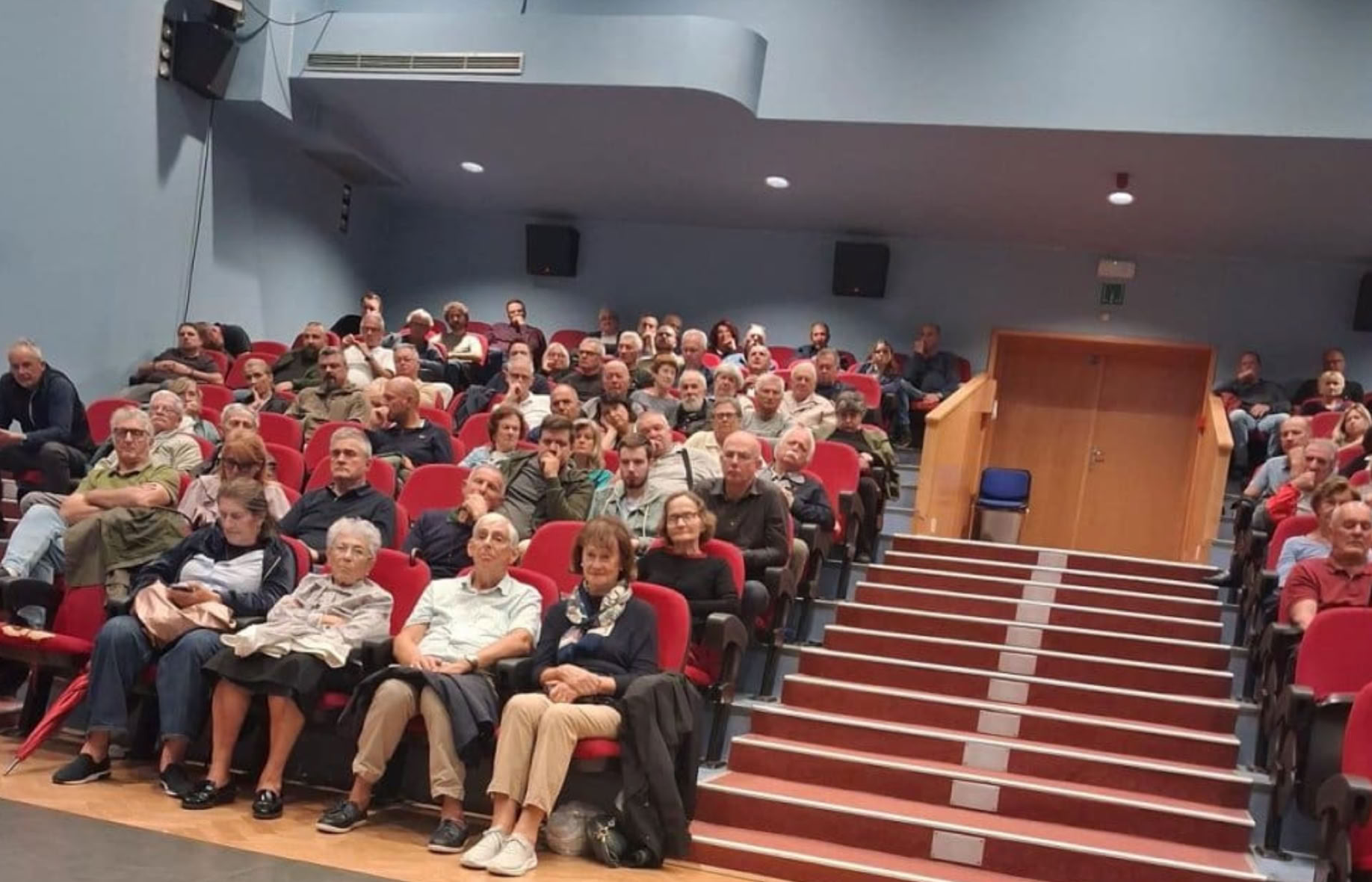
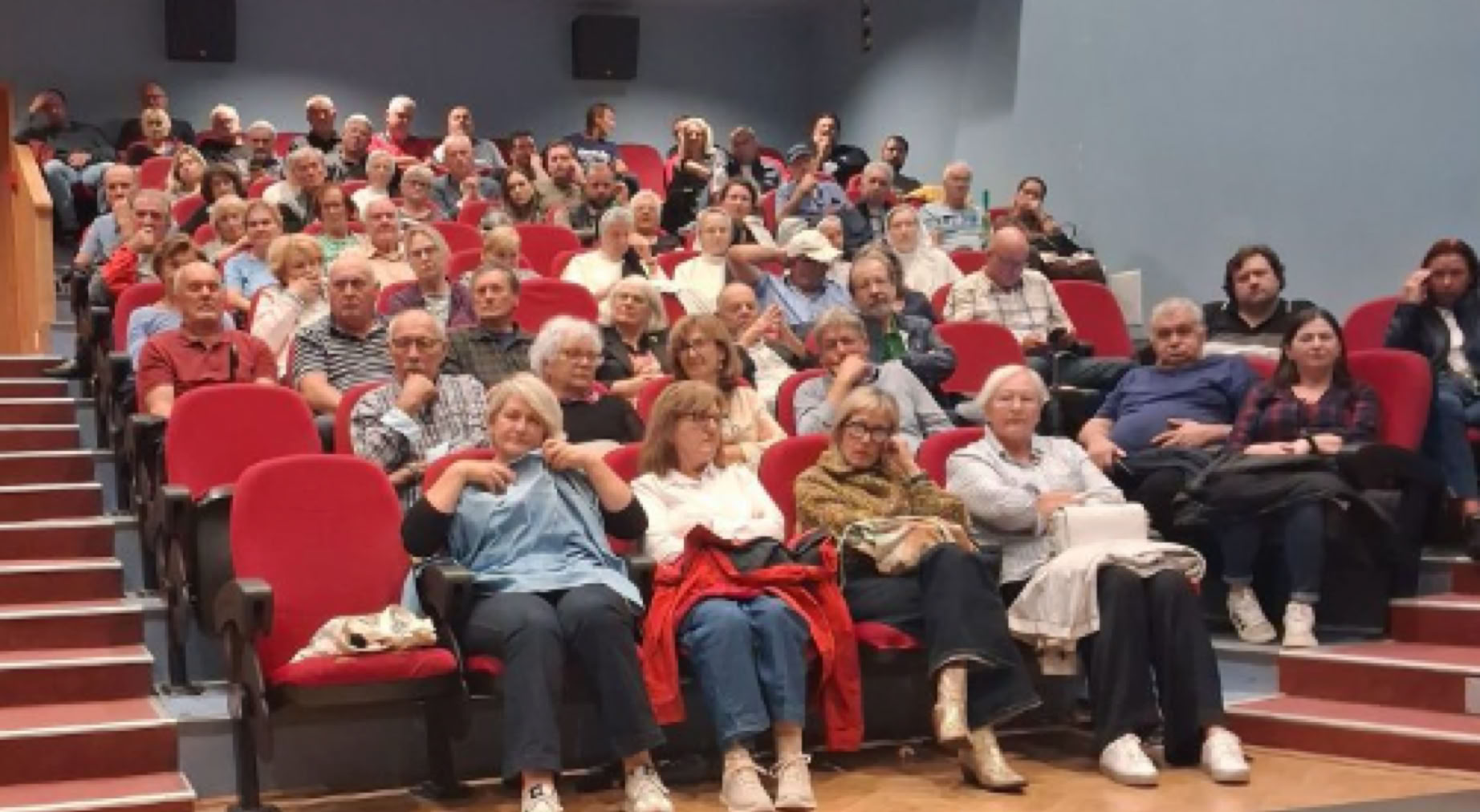
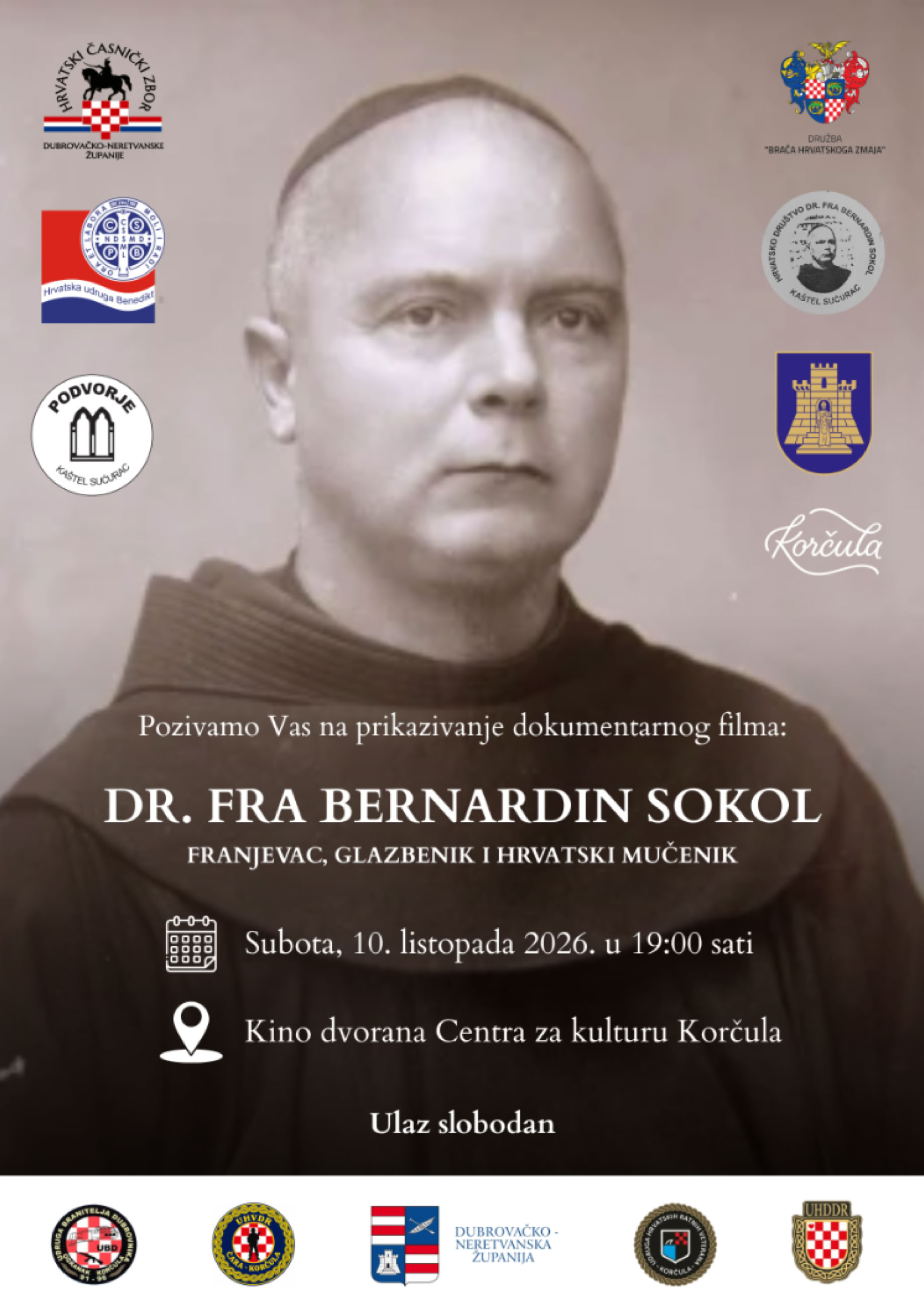
Significant public interest marked the presentation of the documentary film "Dr. Friar Bernardin Sokol – Franciscan, Musician, and Croatian Martyr," held on Saturday, October 10, at the Korčula Cultural Center. The hall was filled to capacity, with the event drawing many residents of Korčula as well as guests from across the Dubrovnik-Neretva County. The evening—dedicated to the life and work of the Franciscan, composer, and professor who spent part of his life on the island of Badija—was co-organized by 12 associations, including veterans' organizations from the island of Korčula and the wider Dubrovnik-Neretva County.
A composer whose musical legacy comprises approximately 350 works
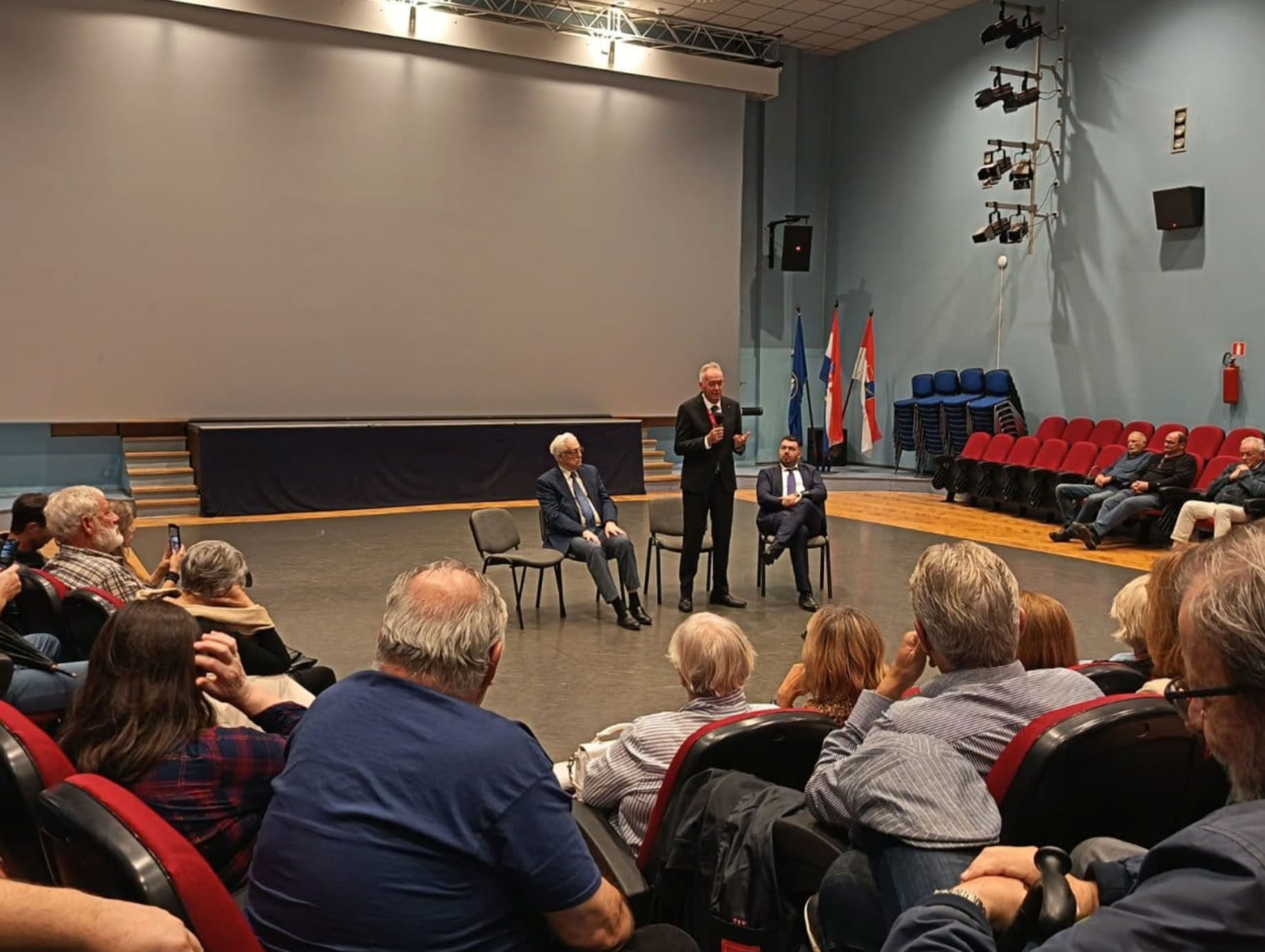
The program was opened by Milivoj Bratinčević, Deputy President of the "Friar Bernardin Sokol" Croatian Society, President of the "Podvorje" Association, and Head of the "Dragon's Table" (Zmajski stol) in Split. In his welcoming address, he expressed his gratitude to those in attendance, the organizers, and everyone who supported the realization of the project.
“Dear guests, I greet you all on behalf of the Society of the Brothers of the Croatian Dragon, the Dr. Friar Bernardin Sokol Croatian Society, and the Podvorje Association. I am delighted that so many of us have gathered here for the screening of the documentary film *Friar Bernardin Sokol: Franciscan, Musician, and Croatian Martyr*, directed by Nikola Knez. The Croatian Film Institute, based in Texas (USA) and funded by donations from our diaspora, produced this film about Friar Bernardin Sokol and gifted it to the Society of the Brothers of the Croatian Dragon on the occasion of the 1,100th anniversary of the Croatian Kingdom. On May 6th of last year, the film was awarded a silver medal at a film festival in Texas.
Mr. Nikola Knez shared a few words for this occasion and asked me to convey his greetings to everyone present; I shall quote him directly: 'The news of the film’s screening in Korčula has deeply moved me and filled my heart with joy. The way in which this event has been organized deserves far more than mere praise; the media coverage and, in particular, the collective of organizations that have supported this screening are truly impressive. An announcement regarding the screening will be featured by the Croatian Film Institute in Texas, as well as by the newly established American-Croatian Film Institute.'" "Heartfelt thanks, Nikola."
Friar Bernardin Sokol spent the greater part of his life on the island of Badija and left a significant mark on the entire island of Korčula—which is the reason we have gathered here this evening. The late Friar Bernardin Škunca—a great admirer of Friar Bernardin Sokol’s life, work, and musical oeuvre—aptly concluded: "THE FALCON FLIES AGAIN!"
Following the screening of the documentary film, historian Ivan Andabak addressed the audience, speaking about the life and historical significance of Friar Bernardin Sokol.
He noted that Sokol was one of the most important Croatian sacred musicians of the 20th century, having composed approximately 350 works. Born in Kaštel Sućurac, Friar Bernardin began his tenure as a professor at the Franciscan Gymnasium on Badija in 1932. "In Friar Bernardin, faith, culture, and human dignity are all embodied." "His music lives on today, and his fate reminds us that no one should be condemned without a trial," noted Andabak.
The Tragic Fate of Friar Bernardin Sokol
Prof. Dr. Mihovil Biočić—wartime director of the University Hospital Centre (KBC) Split and a member of the Friar Bernardin Sokol Croatian Society—spoke about the historical circumstances of the Second World War and the immediate postwar period. In his presentation, he addressed the origins and development of communist crimes, as well as the suffering of Friar Bernardin. As noted during the event, members of OZNA (the Yugoslav secret police) took the friar from the monastery on the island of Badija on the night of September 28, 1944, and killed him without a trial.
"No one has the moral right to be an anti-fascist if they are not also an anti-communist."
(Hannah Arendt)
Not so long ago, communist dogmas were the only truth by which one had to live, and an invisible network of informants ensured that this remained the case. These informants—denunciators, snitches, spies—served as catalysts for the realization of a communist "paradise" on earth, and they were well-rewarded for the evil they perpetrated. Proud communist "comrades"—who would often begin their speeches by declaring, "Comrades, as a communist..."—suddenly transformed themselves into "anti-fascists." This euphemism completely replaced the word "communist"—a term they once wore with pride!
Oh, if only that damned Berlin ("anti-fascist") Wall hadn't fallen—you would still be living in your paradise.
The occasion for this text is the screening of a documentary film in the town of Korčula on October 10, 2026, which allowed the residents of the entire island and the neighboring peninsula to see—for the first time—the other side of a treacherous communist-perpetrated killing: the execution of 664 clergymen, carried out without any indictment, trial, or verdict. Admittedly, there was a sort of "people’s" summary court, or perhaps judicial process—often taking place only after the liquidation had already been carried out!
I extend my heartfelt thanks to all the organizers, distinguished guests, and citizens who, despite the bad weather, came to see and listen to us—the ones who are shattering a false "memory"!
In Korčula, two versions of "memory" were created: one, propagated by the killers—who needed to justify the brutal murder of a friar (a narrative spread throughout the entire communist era, and which persists even today)—and another, whispered version—one that was dangerous to voice—which suggests that it was actually a "comrade" who betrayed his fellow Partisans, not the friar!
However, for genuine scholars, neither version constitutes evidence—with the exception, perhaps, of certain Yugoslav-leaning "scholars" residing in Croatia.
Fearing for their carefully crafted "Memory"—devised long ago—and anxious lest someone might desecrate it, the "antifascists" of Korčula issued a statement. It features long-established phrases and labels drawn from the rich arsenal of Agitprop, alongside some newly acquired ones, such as: "the shameless destruction of universal moral principles," "a grave crime against humanity and truth," and the assertion that "the only discourse and language permitted must be one that consistently speaks of the values forming the foundation of any civilized society"—and so on.
At the very outset, they state: "As antifascists, taking into account all the evidence that unequivocally confirms the shameful, treacherous, and decisive role of Friar Sokol in the liquidation of the Korčula Partisans..." and so forth. I have personally examined a great deal of documentation regarding this accusation—and I am not the only one! Nowhere have I found any evidence to support the claims made by the "antifascists" of Korčula. Let us take things in order:
In his book *Dubrovnik in the Second World War (1941–1945): From Occupation to Liberation* (Dubrovnik, 2013), the Partisan commissar Nikola Anić writes: "(...) in September 1944, a hidden group of about 7 Partisans was located on the small island of Vrnik, near Badija. The Germans received information about them from Friar Bernardin Sokol; consequently, they were all arrested and immediately executed, even though they were entitled to protection as prisoners of war." On page 108 of the same book, he quotes Ivan Jeričević Čompo (head of the OZNA in Korčula), who states that "the Germans captured the Partisans and took them away from Korčula." (Anić and Čompo really should have coordinated their accounts: were the 7 Partisans "executed by firing squad," or were they "taken away from Korčula"!?). It appears that Anić’s claims form the basis for the Korčula-related "memorandum" concerning Friar Sokol! Anić also bases his allegations of Sokol’s supposed betrayal on the OZNA archives; however, Dr. Friar Nosić examined the documents cited by Anić—using the specific reference numbers provided in the book—and found that they actually pertain to entirely different matters. "It seems he simply assigned document numbers at random to substantiate his lies," points out Friar Stipe Nosić.
Dr. Friar Stipe Nosić, from the Friary of the Friars Minor in Dubrovnik, examined all the relevant documentation held at the Croatian State Archives in 2018 (specifically, the OZNA archives in Zagreb, under... (reference number MUP RH/I Kut 1219).
In the documents of OZNA, there is absolutely no evidence that Friar Sokol betrayed anyone! Had there been any betrayal on Sokol’s part, OZNA would surely have highlighted it in large, red letters! Instead, OZNA underlined every instance of patriotic language, as well as any mention of the terms "Croat" or "Croatia." They also flagged the *Hymn to Dr. Ante Starčević*—composed by Sokol to lyrics written by Miho Jerinić in Šibenik in 1938.
It is not my intention to prove Sokol’s innocence (that has already been done by Friar Stipe Nosić and others); rather, I will simply point out some of the blatant lies and logical inconsistencies found in the communist-era *Memorija* (account/record). Some of these claims are so absurd that they reveal the utter impotence and wretchedness of certain "anti-fascist" authors:
The *Memorija* [Memoir] transformed the anthem dedicated to
A. Starčević into an anthem for A. Pavelić.
The *Memorija* claims that a German man named Vilim, who lived in Korčula, translated Friar Sokol’s "betrayal" for the Germans; however, the illiterate authors of the *Memorija* were apparently unaware that Friar Sokol had studied music in Klosterneuburg, near Vienna, and was fluent in both German and Italian!
The *Memorija* further alleges that Vilim informed the nun Manes Karninčić about this "betrayal" by Sokol, and that she, in turn, relayed the information to the Partisans. Ivan Armanda, a scholar at the Miroslav Krleža Institute of Lexicography, examined documents from the Dominican convent in Korčula and established that Sister Manes was not even in Korčula at the time; rather, she was running a school in Žrnovo. She only arrived in Korčula after the war, and so on. There are numerous high-ranking Communist (pardon me—"anti-fascist") officials who dispute both the *Memorija* and Anić’s account:
Jure Srhoj (a former Communist official), in his book *Putovanje dolinom sjenki, Dalmacija 1941. – 1944.* [Journey Through the Valley of Shadows: Dalmatia 1941–1944], published in Korčula in 2019, on page... On pages 399–400, it is written: "On the night of August 20/21, 1944, on the small island of Vrnik, the Germans captured four underground field operatives—all members of the Communist Party of Croatia (KPH)—inside a stone quarry (used as a bunker). In addition to these communist underground operatives, the Germans also captured two German soldiers (a Pole and a German) who had defected to the Partisans in the preceding days. With the exception of one communist (Stipe Malovan), who managed to escape, the Germans took all of them to the prison in Korčula." This raises the question: what about the seven Partisans whom Anić claims were executed by firing squad?
Furthermore, according to Srhoj, two of those arrested on Vrnik—Roko Kršinić and Ive Skokandić (nicknamed "Kamion")—managed to escape from the Korčula prison at night by climbing through the roof; they then swam to Lumbarda. In Lumbarda, they encountered the same German soldier who had been with them in the bunker on Vrnik. The Partisan Stipe Malovan declared him a "spy" (!?) and killed him on the spot.
Pero Lozica, one of the leading communist officials in Korčula during the war, states that there is no mention of any betrayal by Sokol; he has completely excluded Sokol from the narrative regarding the betrayal of the Partisans.
Regarding Anić’s claim of "7 Partisans" being killed—when, in fact, there were only six individuals in the bunker—the only person killed was the German "spy," and he was killed by the Partisan Stipe Malovan. Thus, out of the six Partisans whom Sokol allegedly betrayed, the only one whose fate remains unknown is that of the Pole. Drago Desput, a member of the Judicial Department of the Main Staff of the National Liberation Army and Partisan Detachments of Croatia, stated in a report sent to the Central Committee of the Communist Party of Croatia as early as January 17, 1945: "It was not only Sokol whom the Partisans killed without trial. Many people on the island of Korčula and throughout Croatia were silenced in this same manner."
There are other communist accounts attesting to the integrity of the friar—a man they did not like, just as he did not like them, owing—as he himself stated—to the atrocities they committed. It remains unclear why the Partisans were searching for Sokol in Blato just before Christmas 1943; upon failing to find him, they remarked: "Sokol will come to us, sooner or later." Could it be that he had betrayed someone even back then!?
Comrades—"anti-fascists"—if your own former communist idols say what they say, and if no evidence of any betrayal by Sokol exists within the OZNA archives, why do you not believe your own side?
In *Memorija*, an attempt was made to falsely suggest that the other friars at the Badija monastery supported the Partisans and opposed Sokol! This is simply not true! I shall cite the testimony of just one friar: Andro Vid Mihičić (1896–1992)—a former Franciscan from Badija, art historian, and writer—who studied at the Sorbonne in Paris, where he earned a *licence* in art history in 1927 and another in living Oriental languages in 1929. He went on to become a high-ranking officer in the Yugoslav Army and was undoubtedly well-informed about all these events. Yet, even he did not implicate Friar Sokol! In the book *Crimes and Terror in Dalmatia 1943–1948 Committed by Members of the NOV, JA, OZNA, and UDBA*, by Blanka Matković and Ivan Pažanin (Zagreb, March 2011), it is stated: "Čompo did not merely decide on the killing of Sokol; he held the power of life and death over many. By his own admission, he established 'departments' of OZNA. Many of his 'dispatches' attest to his role in the liquidation of political opponents. Also documented is his attempt to liquidate a young Franciscan from Badija, Friar Jerko Bakotin (also from Kaštel Sućurac), because in May 1945, in Kuna Pelješka, he dared to state publicly that one of his fellow friars had been taken away and killed."
And finally, read the book by your fellow Korčula native, Franko Burmaz, to learn what the anti-fascists did—and how they did it—once they came to power. For any decent, reasonable person, it is distressing to read about your "universal moral principles," "crimes against humanity and the truth," "values that form the foundation of any civilized society," and the like. What connection could you—unreformed communists and pseudo-anti-fascists—possibly have with morality, civilizational values, or humanity itself? Read the resolutions and declarations issued by the European Union! Especially the latest one, from September 19, 2019, which equates Nazism with Communism and mandates the removal of everything reminiscent of any totalitarian regime (streets, squares, busts of totalitarian figures…),. In your infatuation with the ultimate denouncer—and the world’s tenth-greatest mass murderer—J. B. Tito, have you forgotten that for two of the six years of the Second World War, you (all European Communists) were in an alliance with the Nazis (Hitler) and on Stalin’s orders, they SABOTAGED the defense of their own countries as Hitler was conquering them!? Back then, you blamed the detested imperialists—England and France—for the war… That "love" lasted only until your friend Hitler betrayed you and attacked on June 22, 1941!?
Your "civilizational values" are evidenced by horrific liquidations of human beings (roasting people on spits, skinning them alive, drowning them, slaughtering them, and throwing living people into pits…).
And here are just a few more points from an excellent, well-documented book by Franko Burmaz, titled *Victims of Communism on Korčula: A Search for the Truth* (HŽD, Zagreb–Korčula, 2015). Among other things, it states:
The book’s author of the introduction, Dr. Franko Oreb, writes that "…almost all executions on our island were carried out without any trial or formal sentencing…" Furthermore, Oreb notes that "among the victims were priests and intellectuals upon whom terrible and blatantly false accusations and slanders were heaped… yet they had dedicated their lives to serving their own people, steadfastly defending their faith, morality, and national sacred values. According to the plan devised by those who issued the orders, they were to be liquidated—as many of the nation’s intellectual and spiritual leaders as possible were to be killed—so that the people could more easily be led astray into error."
On page 26. in his book Burmaz states: "Today, it is reliably known about four pits, mass graves where the communists threw liquidated people: Vrannina, Šibalovo noge, Paklenica and Bultina, and two mass graves at the cemetery of St. Luke in Korcula and the cemetery of St. Cross in Blato".
On page 151, he states: "In the town of Korčula, liquidations were carried out on three occasions: after the capitulation of Italy (October 1943), the departure of the Germans (autumn 1944) and the biggest crimes, which were committed after the end of the war, in the Bultina cave."
Furthermore, he concludes: "It can be said with certainty that after the end of the war, the communists on the island of Korčula killed more of their "peaceful and unarmed citizens" than the Italian and German occupation combined, even though the people were against the occupiers and helped the partisans."
On page 171 among other things, he states: "...the liquidations were a consequence of the decisions of the party committees, which judged that the liquidations (executions) were in the interest of the party and the revolution" and further states that "many people were killed without knowing their identity and without any records, which is why it is not known how many were killed in the pits of Korčula!"
CONCLUSION
After the words from Burmaz's book, is something not clear to anyone???
Partisan communists from Korčula killed Fr. Bernardin Sokol, innocent and without trial, on September 28, 1944 and threw him into the sea. It's a war crime! Following that war crime, they did everything in their power to destroy his works and ensure that he would not be spoken of.
In Dubrovnik (and throughout Croatia), the Communists committed both genocide and aristocide against the Croatian people! Mountains of Croatian bones are emerging from countless pits and trenches… Even today, these "anti-fascists"—who constantly preach about civilizational values, equality, human rights, and so on—refuse to acknowledge their atrocities, and they have never been brought to trial. Instead of falling silent, they continue to lie and insult the remains of the dead!
A question arises regarding the murder of Prof. Dr. Fr. Bernardin Sokol—a brilliant musician and martyr:
If he was guilty, why was it forbidden to reveal that he had been killed!?
If he was guilty, why was he killed in secret!?
If he was guilty, why was it mandatory to remain silent about him!?
If he was guilty, why was he not put on trial!?
There was time for a trial; the Germans had already left! September 13th marked the liberation of Korčula from fascism—only to be followed by Communist occupation—yet Fr. Sokol was murdered on September 28, 1944.
"Being stupid is when you know the truth, you see the truth,
but you still believe the lies."
(Morgan Freeman)
Among the guests were numerous representatives
of local and regional authorities.
The film presentation was attended by representatives of veterans' associations, as well as officials from local and regional government. The delegation of the Croatian Officers' Corps of Dubrovnik-Neretva County was led by its president, Nikša Sentić, while the City of Korčula was represented by Mayor Frano Jeričević and City Council President Ivana Fabris. Also in attendance were the Head of the Municipality of Orebić, Tomislav Ančić, and the Deputy Prefect of Dubrovnik-Neretva County, Joško Cebalo. The local veterans' association, UHDDR – Korčula City Branch, led by its president Krešimir Pecotić, was responsible for the venue arrangements and protocol. The event was organized to a high standard.
The memory of Friar Bernardin lives on in Korčula
Ahead of the presentation of a documentary film about the life and work of Friar Bernardin Sokol, the subject was also discussed on Radio Korčula, featuring guests Milivoj Bratinčević, Mihovil Biočić, and Ivan Andabak. The significant public interest and a packed hall at the Cultural Center demonstrated just how enduring the memory of Friar Bernardin Sokol remains among the residents of Korčula.
All Content © 2015-2026 American Croatian Film Institute, All Rights Reserved